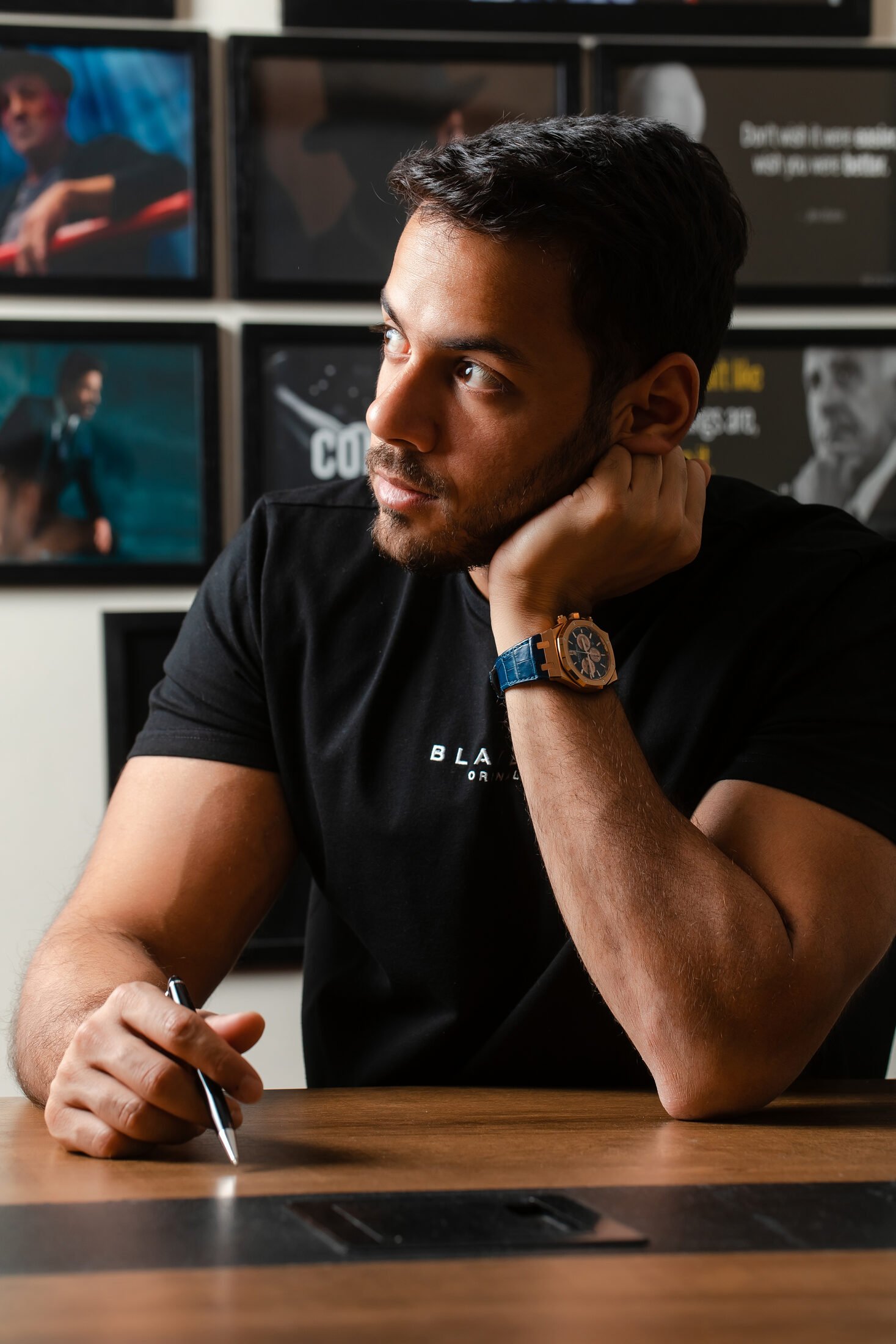
Shakti
Chauhan
Shakti Chauhan is well known for hosting private poker games for the rich & elite of Delhi, London, and Dubai. His clients include celebrities, politicians and billionaires.

$5 Million.
Playing poker, however, has been secondary to the business he has built around it. His core business is curating high-stakes poker games. At his peak he was running multiple games simultaneously across cities, backing upcoming poker players, and collaborating with top game organizers across Asia and the Middle East.
He has built a network that connects him to virtually every serious player and organizer operating at the highest level in the region. Any top poker player in Asia is, at most, one or two degrees of separation from him.
To be a great poker player is not so important. To have a likeable personality is more important — because that gets you into rooms where the richest, most influential people play poker for fun.
These are the people you want to play with, because they are the ones who can afford to lose.
I made ten times more money, and a hundred times better connections, than many of my friends who are far better poker players than me.

As a boy, Shakti grew up in Delhi. At the age of eleven, he was sent to Mayo College, Ajmer — one of India’s most prestigious boarding schools, where sons of royal families and the country’s elite have studied for generations. Mayo College shaped him: discipline, connections, and the instinct for how to conduct himself in rooms where standards are high.
After Mayo, he trained to become a commercial pilot in Palm Springs, California. Shakti was drawn to flying not by a childhood dream but by the same quality that would define everything that followed: a large appetite for risk and adventure. He had no interest in a stable, predictable life. He never ended up flying commercially. Poker got there first.
His friend Bhavay was watching the World Series of Poker on TV. Shakti walked in, saw the prize money — eight or nine million dollars — and noticed that some of the players at the final table were barely older than he was. Shakti was intrigued.
What drew him was not the money — it was the idea behind the money. As a child he had loved games of every kind: sports, video games, cards with family, anything competitive. The notion that you could play a game, get better at it, and make money doing so felt, to him, like the dream life.
When he returned to Delhi, he continued playing poker while applying for airline jobs. Within a few months, he was making more from poker than a pilot’s salary would have paid. He never looked back.


Shakti learned poker the way most people do: a friend taught him. It felt simple enough. And for a while, it seemed to be working — he was winning, enjoying the game, and making money. What he did not realize was that everything he had learned was quietly building toward a problem he could not yet see.
The problem with learning poker casually is that you don’t know what you don’t know. You are making mistakes without realizing they are mistakes. Bad habits turn into bad instincts. And by the time the losses start mounting, the bad foundation is already so deeply set that the player cannot even see it. The player believes he is unlucky, and keeps going — practicing the same mistakes, at higher and higher stakes.
This is what happened with Shakti. For seven years he kept losing, despite passion and commitment. What was missing was the correct foundation, and no amount of effort or persistence could compensate for that.
in the wrong direction.
The turning point came when Shakti finally did what he should have done from the beginning: he sought out professional coaching. He hired some of the best poker players in the world to coach him. He hired Elliot Roe, one of the most sought-after mindset coaches who works with poker players, MMA fighters, and high-performance individuals.
Then he went back to the fundamentals. Every bad habit was identified and corrected. It was not a quick process — fixing a weak foundation never is. But once it was done, the results were immediate and decisive. He recovered all of his losses. He went on to win over $5 million in profit.
Once he started winning, everything else followed. The games got bigger. The rooms got better. The people sitting across the table changed — from local players to some of the most powerful and influential figures in Asia and the Middle East. These were not connections he sought out. They were the natural consequence of playing in the right games, with the right foundation underneath him.

Goldmine
The biggest misconception in poker is that in order to be successful, you have to be good at poker. Actually — you don’t.
Success in poker is like digging for gold. The skill of playing poker is like the skill of digging. But the main thing is not the skill of digging. The main thing is to find a rich goldmine.
A rich goldmine is a poker game full of wealthy people who play for enjoyment — millionaires, billionaires who can afford to lose. In this game, winning is not a struggle — it is inevitable.
A bad foundation in poker leads to years of losses.
Fixing bad habits is ten times harder than learning correctly the first time.
Either learn poker with a professional from the beginning — or don’t start playing poker at all.
People dedicate their lives to becoming great at poker. Eventually they realize: they have climbed the wrong mountain. The best poker players don’t get rich.